
Dry Vs Moist Nicotine Pouches: What’s the Difference?
The main difference between moist and dry nicotine pouches is their moisture content, which can affect nicotine and flavour release and how the pouch feels. Moist snus is typically softer and may release nicotine and flavour faster, while dry pouches are firmer and typically release contents gradually.

Best Bits
- Moist pouches are typically softer, while dry pouches have a firmer texture.
- Moist pouches may release nicotine and flavour faster than dry pouches.
- Faster nicotine release does not necessarily mean more nicotine overall.
- Moisture levels, pH, and pouch ingredients all influence the nicotine experience.
- You can check individual products’ moisture levels on NicoLeaks.
Dry Vs Moist: What’s the Difference?
Nicotine pouches can be either moist or dry. But what does this actually mean?
A moist or dry pouch refers to the moisture levels in a pouch, which is affected by two things:
- Water
- Humectants (e.g. propylene glycol, glycerol)
Humectants are ingredients that attract and retain moisture. This helps the pouch to feel soft, prevents it from drying out, and supports the overall performance of the pouch.
Moisture levels can affect the overall experience of a nicotine pouch. The table below gives a quick overview on the differences between moist and dry nicotine pouches:1
| Moist pouches | Dry pouches |
| Softer pouch | Firmer pouch |
| More drip | Less drip |
| Less reliance on saliva to release nicotine and flavour | More saliva needed to release nicotine and flavour |
| Quicker flavour release | Slower flavour release |
| Nicotine sensation can be perceived quicker | Nicotine sensation can be perceived slower |
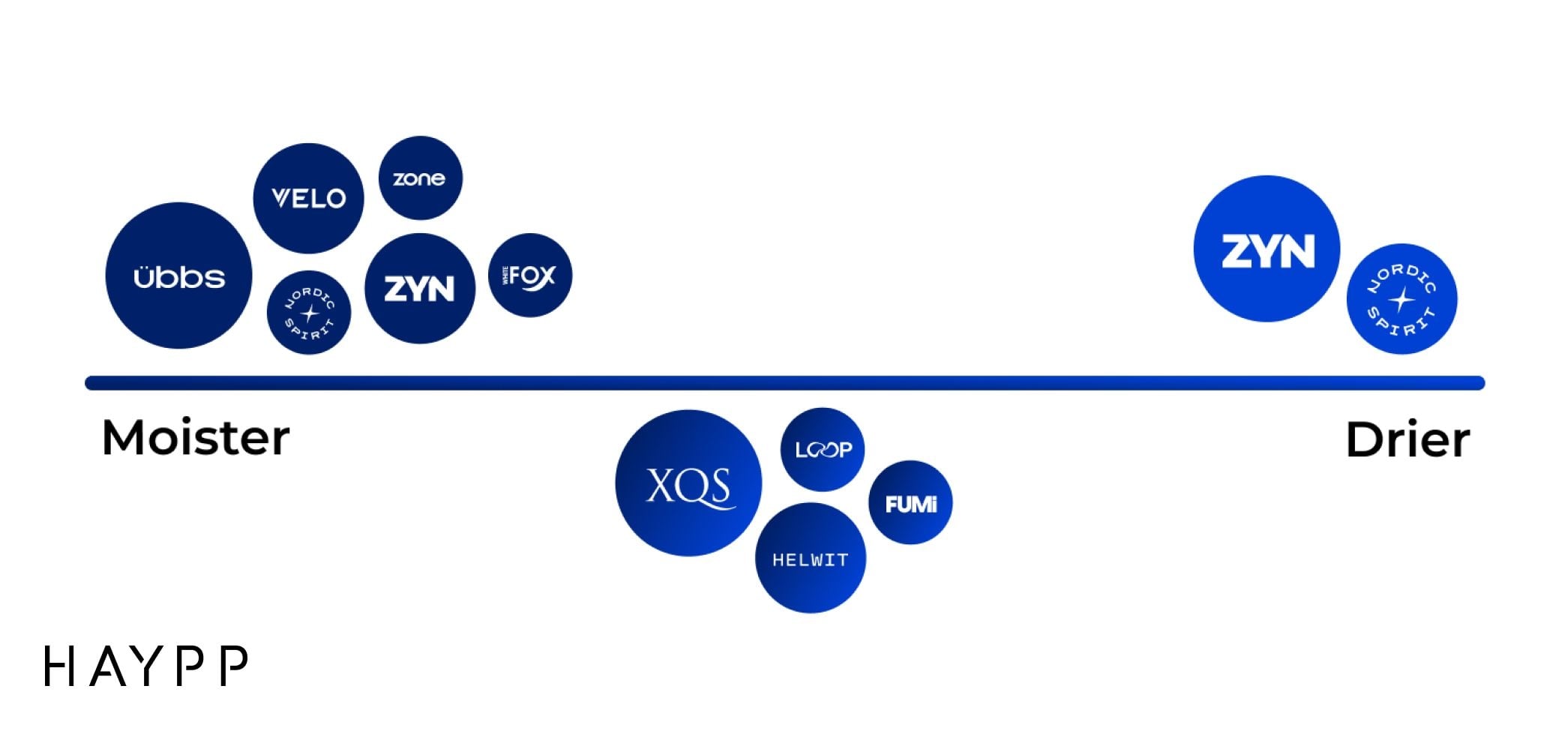
There is no universal percentage of moisture content that separates moist from dry nicotine pouches. Instead, it’s more accurate to think of it as a spectrum.
Some pouches contain relatively little moisture, while others contain considerably more. Many products fall somewhere in between.
How Do Moisture Levels Affect Pouch Experience?
Nicotine and flavour compounds need to dissolve before they can be released and absorbed through the mouth lining.
Moisture levels help to activate the nicotine and flavour inside the pouch. Typically, having more moisture in the pouch speeds up this process.
Dry pouches have less internal moisture, so they rely more on the saliva in your mouth to activate the nicotine and snus flavour.1 This can mean it takes a little longer for ingredients to dissolve in drier pouches.
In other words:
- Moist pouches → may release nicotine and flavour quicker
- Dry pouches → may release nicotine and flavour slower
While moisture content can affect how a pouch feels in the mouth and how quickly its ingredients dissolve, it’s also only one aspect of a pouch’s formulation.
Other factors, including pouch material, ingredients, and pH levels, can also influence nicotine release and absorption.1
Moisture Levels and Pouch Intensity
Now you know that moisture levels can affect nicotine release. But how does this affect how you experience a nicotine pouch?
A quicker nicotine and flavour release can create a more intense sensation in the beginning.
For some users, this can make the pouch feel stronger than it actually is, but it does not change the actual nicotine pouch strength. (If you’ve ever used two pouches with the same strength that feel different in intensity, this could be why.)
Cooling compounds are another factor that can make pouches seem stronger than they actually are. These compounds are typically found in “icy” mint pouches that have a cooling or tingling sensation that can feel intense to some users. (This is different to the burning sensation sometimes associated with nicotine pouches).
The scale below shows how the most popular brands on Haypp compare in terms of moisture content:
Moist Vs Dry Pouches: What the Science Says
A 2026 scientific publication by Swedish Match (the manufacturer of ZYN) carried out two separate clinical trials on nicotine pouches. One looked at dry pouches, while the other examined moist pouches.2
The studies compared how participants experienced two different ZYN pouches:
- 6mg pouches - dry, with around 3% moisture levels
- 9mg pouches - moist, with around 40% moisture levels
What Did the Trials Show?
The two trials had some interesting findings:
- The amount of nicotine entering participants’ bloodstreams (nicotine absorption) was similar for dry and moist nicotine pouches
- There was also no difference in the amount of nicotine released from the pouches during use
Nicotine Absorption Vs Nicotine Release
The trials measured nicotine absorption and nicotine release as two separate measurements.
This is because not all nicotine released from a pouch is absorbed into the bloodstream. For example, some nicotine may be swallowed with saliva.
The findings show that even though the moist pouches contained more nicotine, they released a smaller proportion of their total nicotine content.
In practical terms, this highlights an important distinction: a pouch containing more nicotine doesn’t necessarily mean more nicotine absorbed overall.
The trials also asked participants to measure how quickly they felt satisfied after using the moist and dry pouches:
- Moist pouches delivered highest satisfaction levels earlier (around 12-30 minutes)
- Dry pouches delivered received satisfaction levels later (around 30-45 minutes)
How to See if Your Pouch Is Moist or Dry
Some brands, like Nordic Spirit, will label their products as dry or moist. However, it’s quite rare that brands do this.
The best (and only) way to actually find out if the moisture levels in your pouches is to go to Nicoleaks. Type in any nicotine pouch product and check the “Moisture levels” column.
What Is Nicoleaks?
Nicoleaks was created by Haypp and is one of the world’s largest publicly accessible databases of nicotine pouch test results.
It was set up because we believe that it should be easy and free for consumers to access important information about the products they are using.
We send pouches to be tested by the independent laboratory Eurofins and publish the results on Nicoleaks. Pouches are also tested for nicotine content, pH levels, weight, and trace metals.
A pouch with a higher moisture content generally contains more water than one with a lower measurement, but that doesn’t necessarily mean it will feel wetter in the mouth or deliver nicotine more quickly.
Rather than looking for a specific percentage that defines a pouch as “moist” or “dry”, it’s more useful to compare measurements across products and consider moisture content alongside other pouch characteristics.
Final Thoughts
The difference between moist and dry pouches is how much moisture they contain.
Moist pouches tend to feel softer, and may contribute to faster nicotine and flavour release. In contrast, dry pouches are generally firmer and may take longer to release their contents.
Other factors, including nicotine content, pH levels, and other ingredients, also impact nicotine and flavour release, as well as overall experience.
Whether you choose moist or dry pouches comes down to personal preference. Start exploring nicotine pouches on Haypp UK today to find the right snus for your preference.
FAQs Moist Vs Dry Nicotine Pouches
Are moist nicotine pouches stronger than dry pouches?
Moist pouches are not necessarily stronger than dry pouches. Moist pouches may release nicotine more quickly, which can make the initial sensation more intense.
However, moisture levels do not determine the nicotine strength of a pouch - check the label or online for information about the actual nicotine strength.
Do dry nicotine pouches last longer than moist pouches?
Dry nicotine pouches may release flavour more gradually because they need more saliva to dissolve their ingredients. However, this doesn’t necessarily mean that they last longer.
How can I tell if a nicotine pouch is moist or dry?
Sometimes, brands label their products as “dry” or “moist”. You can also tell by touching a pouch; moist pouches generally feel softer, while dry pouches tend to be firmer.
You can also check the measured moisture content of individual products on Nicoleaks.
Which is better, moist or dry nicotine pouches?
Neither moist nor dry is necessarily better as it depends on your personal preference.
Moist pouches may suit users who prefer a softer texture and quicker flavour and nicotine release. Dry pouches may appeal to those who prefer less drip and a more gradual experience.

