
Proposed Vape-Free Places Regulation Misses the Mark
The UK’s upcoming Tobacco & Vapes Bill proposed vape-free spaces, with the aim of protecting public health. However, critics, including Haypp, argue that these proposals lack evidence, impose costs without clear benefits, and risk undermining harm reduction efforts by equating vaping with smoking.

Key Takeaways
- The proposed vape-free rules lack strong evidence of meaningful public harm.
- Government impact assessment does not indicate a public health benefit.
- Vaping differs from smoking, with significantly lower second-hand exposure risks.
- Policies may be driven by precaution rather than clear scientific evidence.
- Treating vaping like smoking risks discouraging smokers from switching.
Much-Needed Regulation–That Risks Overshooting
The UK Parliament is moving forward with the much-needed Tobacco & Vapes Bill, which will strengthen youth protection and regulate newer products like nicotine pouches.
However, one measure risks overshooting the evidence and could place unnecessary burdens on adults, businesses, and public health progress.
A public consultation is currently underway on proposals to extend smoke‑free rules to vaping, and anyone can respond here (through May 8).
Below, we explain why mandating vape-free spaces limits adult choice for no good reason.
1. A Ban in Search of a Problem
Right now, there are no legal restrictions in the UK on where people can vape, although many venues – shops, pubs and clubs – set their own policies.
The new bill would give the government broad powers to change including the ability to “make places that are smoke-free also vape-free.” In practice, this could include banning vaping in shops, restaurants, clubs, pubs, and bars.
Good public health policy should protect people from genuine harm. But the case for sweeping vape restrictions often rests on precaution rather than any genuine evidence.
What Public Health Bodies Say: Low Risk from Second-Hand Vape Exposure
UK health authorities have consistently said that the risks from second-hand vapour exposure, are extremely low.
- NHS Public Health England: “there is no evidence of harm to bystanders from exposure to e-cigarette vapour and the risks to their health are likely to be extremely low.”
- Cancer Research UK: “There is no good evidence that second-hand vapour from e-cigarettes is harmful. As vaping is still relatively new, we can’t be sure there aren’t any long-term effects to people who breathe in someone else’s vapour. But this is unlikely to be harmful. Passive vaping is not the same as passive smoking is because e-cigarettes do not contain tobacco.”
When an evidence base does not show meaningful harm to others, blanket bans in cars, outdoor areas, or general public spaces start to look less like safety measures and more like symbolism.
Public-health interventions should focus on real dangers, not hypothetical discomfort.
2. All Cost and No Benefit
The government’s own Impact Assessment raises an uncomfortable questions about the proposed vaping restrictions – they don’t quantify costs (citing insufficient evidence), but who exactly is to benefit?
The official impact assessment said there is “no monetised benefit.” In other words, the government has not been able to quantify any measurable gains.
But there are substantial costs:
- Legitimate businesses will be expected to shoulder the costs (new signage, additional employee training).
- Multiyear financial burdens on enforcement bodies and local authorities – which are responsible for policing the new rules.
As the Impact Assessment and parliamentary explanatory materials highlight, these measures pose “substantial compliance and enforcement costs” without any clearly measurable public-health benefit to offset them.
3. Regulating for the Sake of Regulating
Good policy targets harm, not harmless behaviour.
Vaping and smoking are not the same. Cigarettes burn continuously and produce side-stream smoke (the main driver of second-hand exposure). Vapes don’t burn and don’t emit anything when not being puffed.
Research backs this up. A 2015 study of indoor air quality found that levels of fine particles (PM2.5) that reach deep into the lung were similar in the homes of non-smokers and people who vape but 58x higher in the home of a smoker.
Indeed, many everyday activities have far higher air-quality impacts:
• Frying or gas cooking can produce peaks above 500 µg/m³
• Nail and beauty salons can have levels above 200 µg/m³
• Urban roadside pollution ranges from 10–50 µg/m³
Exhaled vape aerosol contains levels of fine particles similar to what a scented candle gives off.
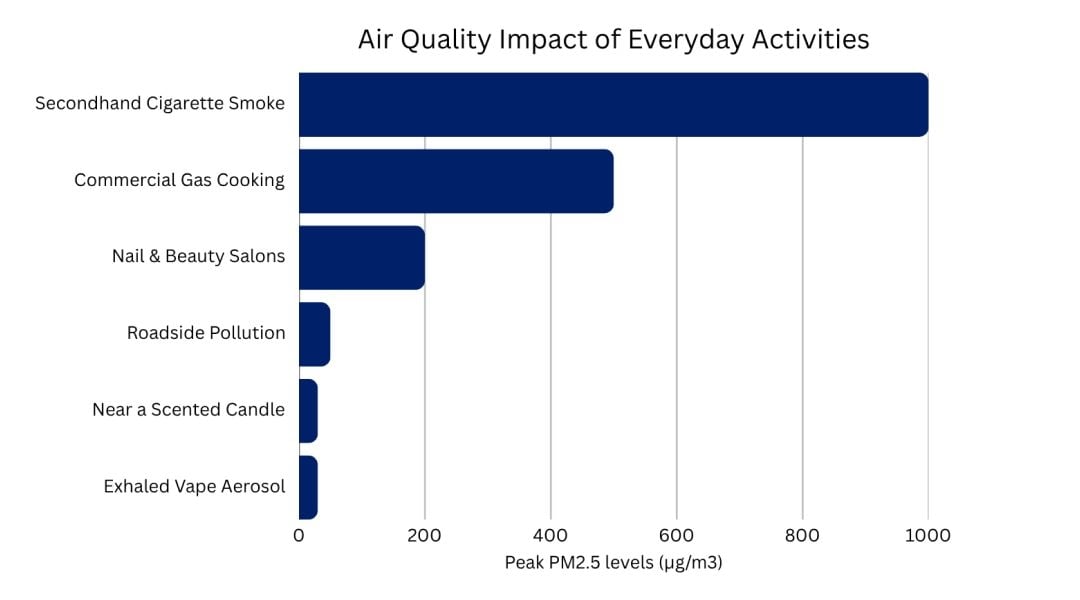
Blanket vaping bans ignore this information and enact policies that look decisive but achieve little.
4. Bad Science (or No Science) Driving Policy
The vape-free space measure relies on precaution rather than data. The government’s own analysis states that due to limited evidence:
- Benefits cannot be monetised
- Impact on prevalence is unknown
- Health improvements cannot be estimated
In other words, there is no demonstrated health benefit from several key measures. However, there is evidence that:
- Secondhand vapour exposure is very low
- Many proposed exposure concerns are not supported mechanistically
- Environmental concentrations are often comparable to background levels
If science isn’t driving the policy, something else is. And that should concern anyone who values evidence‑based regulation.
5. Risking a Return to Smoking
Treating vaping like smoking can push people back to cigarettes.
The government’s own analysis warns of the risk. A 2022 Office for Health Improvement & Disparities report cited in the Impact Assessment said:
“Interventions on absolute harms of vaping that aim to deter young people need to be carefully designed so they do not misinform people (particularly smokers) about the relative harms of smoking and vaping.”
A recent study reported that an estimated 125,000 people in England began using vapes to move away from cigarettes in the first year after the government-funded “Swap to Stop” campaign.
The lead author noted that “People who use vapes are about 50% more likely to quit smoking successfully than those who use nicotine replacement therapy, and quitting smoking substantially reduces the risk of many serious diseases.”
Why Accurate Public Messaging Matters
If public messaging starts saying:
“Vaping is basically the same as smoking, which is why it’s banned in all the same places.”
…then why would a smoker switch?
Misclassifying low‑risk products as high‑risk can:
- Create false equivalence in the public mind
- Discourage switching among current smokers
- Potentially slow progress in reducing smoking prevalence
New policies that blur the distinction between smoking and vaping risk undoing hard‑won harm‑reduction gains by nudging smokers away from proven, lower‑risk alternatives.
Conclusion: A Course Correction on Vape-Free Spaces
Extending smoke-free rules to vaping risks undermining the progress the UK has made in reducing smoking.
It would also impose real costs on individuals and businesses with no gains. A more balanced approach would ensure that any vape-free policy is justified by credible data and clear objectives.
